[SKYFLAG Research] In 2026, “Oshi-katsu” (Supporting Favorites / Stanning) and “Taipa” (literally Time Performance = Time Efficiency) Trends Permeate Sports Spectatorship! A Clear Polarization Emerges Between Participatory Youth and Stability-Oriented Older Generations
A Comprehensive Study on the Expansion of Community Culture Among Digital Natives and How Sports Streaming Integrates into Lifestyle
As part of the marketing research business operated by Skyfall Inc. (Headquarters: Minato-ku, Tokyo; CEO: Tomokazu Hasegawa; hereinafter “Skyfall”), a survey on “Sports Spectatorship” was conducted using “SKYFLAG Research” targeting 4,300 men and women nationwide aged 18 to 59 (Survey Period: Monday, February 2, 2026 – Friday, February 6, 2026).
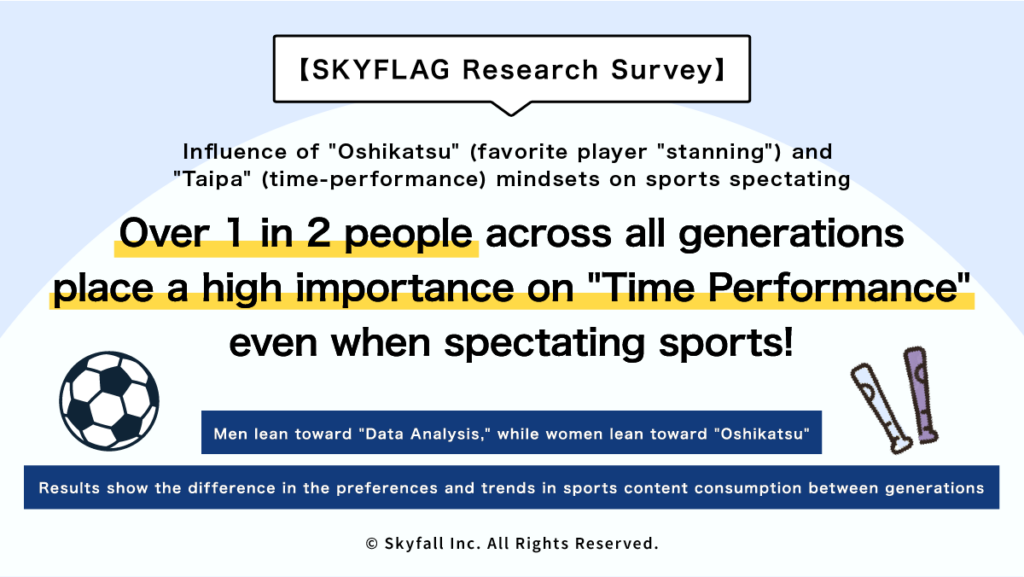
With major international sports events scheduled for 2026, this survey aims to highlight various trends such as the spread of experience-focused consumption centered around the young demographics, and viewership that balances time efficiency with social interaction.
*While approximately 350 to 700 responses were collected for each gender and age group, the data has been weighted and aggregated according to the population composition ratio of Japan, resulting in the following sample breakdown: Men (29 and under [18–29]: 503, 30s: 455, 40s: 579, 50s: 649) and Women (29 and under [18–29]: 480, 30s: 437, 40s: 560, 50s: 636).
[ Research Summary ]
- In 2025, 48.3% of men aged 29 and under watched sports live at venues. Attendance frequency is highly concentrated among the younger demographic, revealing distinct differences in both viewing mediums and frequency across generations and genders.
- Modern sports streaming viewership is heavily linked with “live social media commentary.” Over 40% of users aged 29 and under watch sports while interacting with others online. More than half of all generations have adopted a viewing style that prioritizes this approach—the one based in time efficiency (“Taipa”).
- A clear difference in desired experiences emerged: Men seek “data analysis,” while women focus on “Oshi-katsu” (supporting favorite athletes). Gender differences were also evident in the demand for additional streaming features and spending habits on merchandise, with the youth demographic demonstrating an exceptionally high desire for content consumption.
- Regarding viewership intent for 2026, a year filled with successive international tournaments, the data showed that women displayed the highest interest in the “Olympic and Paralympic Games,” while men focused on the “WBC” and “World Cup,” highlighting distinct preferences and enthusiasm depending on gender and age group.
2025 Sports Spectatorship: 48.3% of Men Aged 29 and Under Watched Live at Venues. Viewership Frequency is Heavily Concentrated Among the Youth Demographic, Revealing Clear Differences Across Generations and Genders.
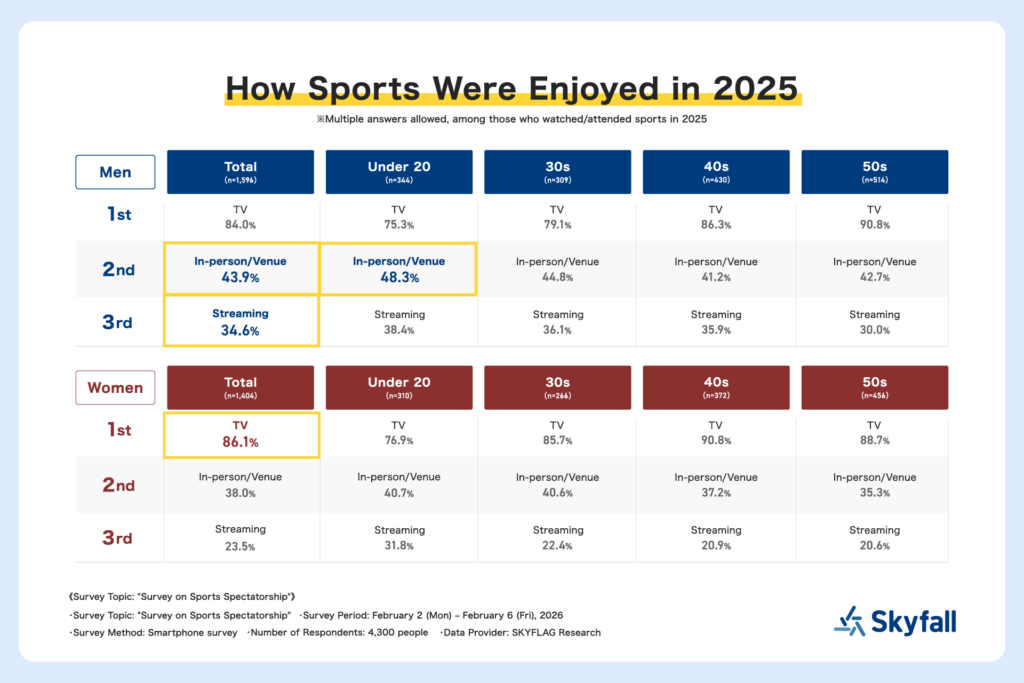
When 4,300 men and women nationwide aged 18 to 59 who watched any sports in 2025 were asked about their “methods of sports viewership” (multiple answers allowed), men (n=1,596) scored higher than women (n=1,404) for both “live at venue” and “online streaming.” However, no significant difference was observed for “television viewership.” Broken down by age group, both “live at venue” and “online streaming” showed higher percentages among younger demographics. Notably, among men aged 29 and under (n=344), the percentage for “live at venue” reached 48.3%, revealing that approximately one out of every two young male sports viewers attended live events at stadiums or arenas.
Next, when 1,234 individuals who watched sports live at venues in 2025 were asked about the “frequency of live venue attendance,” those attending “at least once a month” (combining “about once a week,” “2–3 times a month,” and “once a month”) accounted for over 30% of the totals among men aged 29 and under (n=166), women aged 29 and under (n=126), and men in their 30s (n=138). In contrast, men in their 40s and older hovered around 20%, and women in their 30s and older fell below 20%.
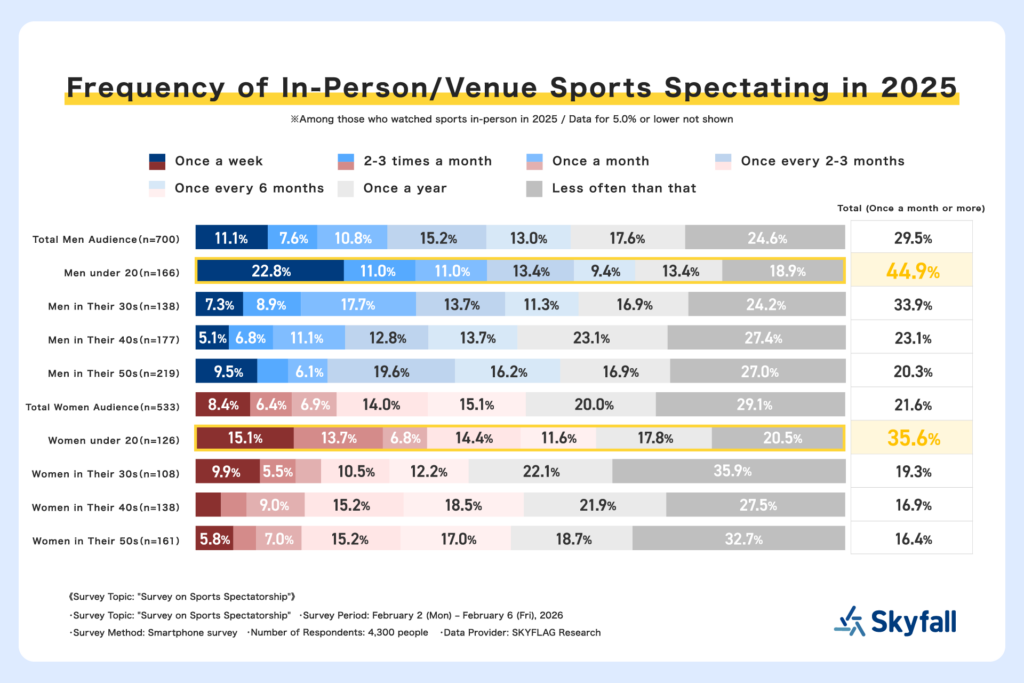
The results show that while male and younger viewers frequently enjoy sports using online streaming and live venue attendance, television remains the mainstream medium for female viewers. Furthermore, for both men and women, attendance frequency declines from their 30s onward, showing differences in spectatorship styles and levels of enthusiasm depending on their life stages.
Modern Sports Streaming Viewership Is Heavily Linked with “Live Social Media Commentary.” Over 40% of Users Aged 29 and Under Watch Sports While Interacting Online. Over Half of All Generations Prioritize Time Efficiency (Taipa).
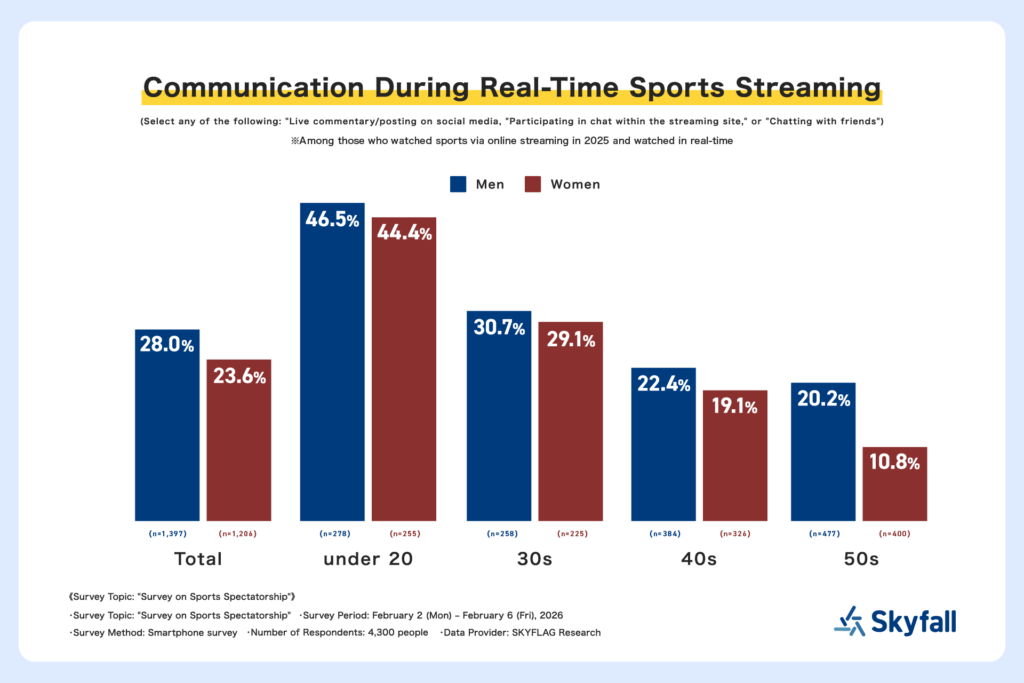
Among those who watched sports via television or online streaming in 2025, 2,604 real-time viewers were asked what they do while watching sports in real time (multiple answers allowed). The data showed that viewers who engage in communication while watching (selecting “posting/commenting on social media,” “participating in streaming site chats,” or “talking with friends”) were predominantly in the age group of 29 and under for both genders—with men (n=278) at 46.5% and women (n=255) at 44.4%. Across all demographics, women in their 50s (n=400) recorded the lowest rate at 10.8%, clearly indicating that younger generations are far more likely to engage in social interaction while viewing sports.
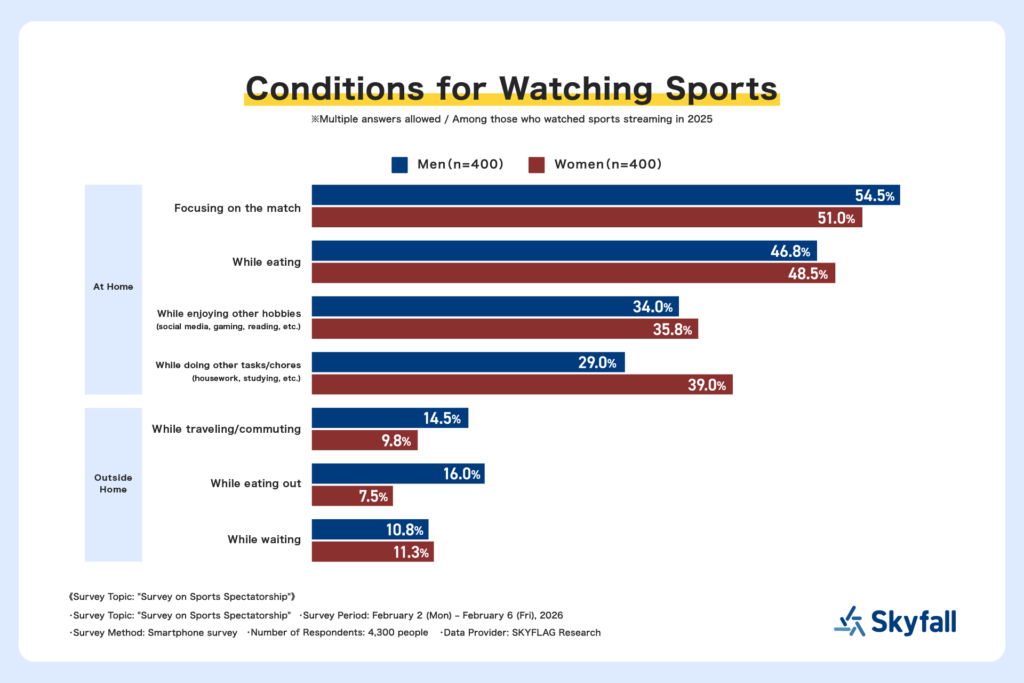
Next, when 800 individuals who watched sports via streaming in 2025 were asked about the “conditions in which they watched the events” (multiple answers allowed), gender-based data (n=400 each) revealed that men surpassed women by over 3.0 percentage points in categories such as “concentrating on the match (at home),” “commuting/traveling,” and “eating out.” On the other hand, women outperformed men by over 3.0 percentage points in the category of “watching while doing other tasks (at home).”
This suggests that while women tend to watch sports in between daily chores and meals, men tend to dedicate their full attention to the match, demonstrating a clear variation in spectatorship styles between genders.
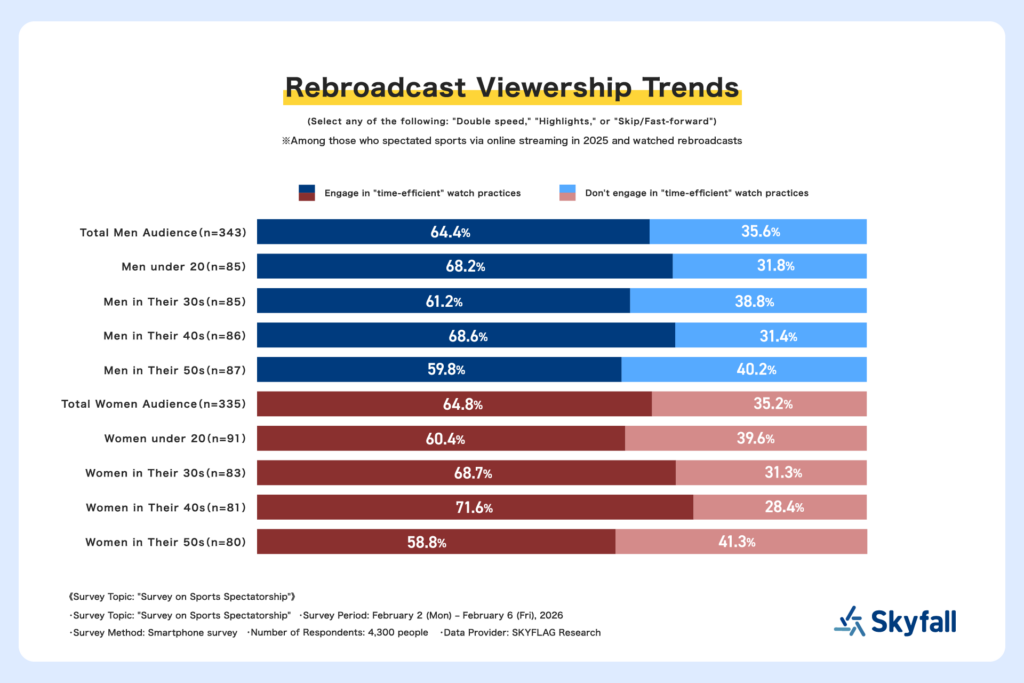
Furthermore, among those who watched sports via streaming in 2025, 678 viewers who utilized archive/catch-up streaming were asked about their “archive viewing style” (multiple answers allowed). Viewers prioritizing time efficiency (Taipa)—defined as selecting “2x speed,” “highlights,” or “skipping/fast-forwarding”—recorded their lowest rate among both men and women in their 50s (remaining below 60%). However, it was discovered that more than half of all genders and generations have integrated time-efficient watch styles into their routines.
Men Seek “Data Analysis,” While Women Focus on “Oshi-katsu” (“Stanning”). Gender Differences are Clear in the Demand for Additional Streaming Features and Spending on Merchandise, with the Youth Demographic Exhibiting a Particularly High Tendency for Content Consumption.
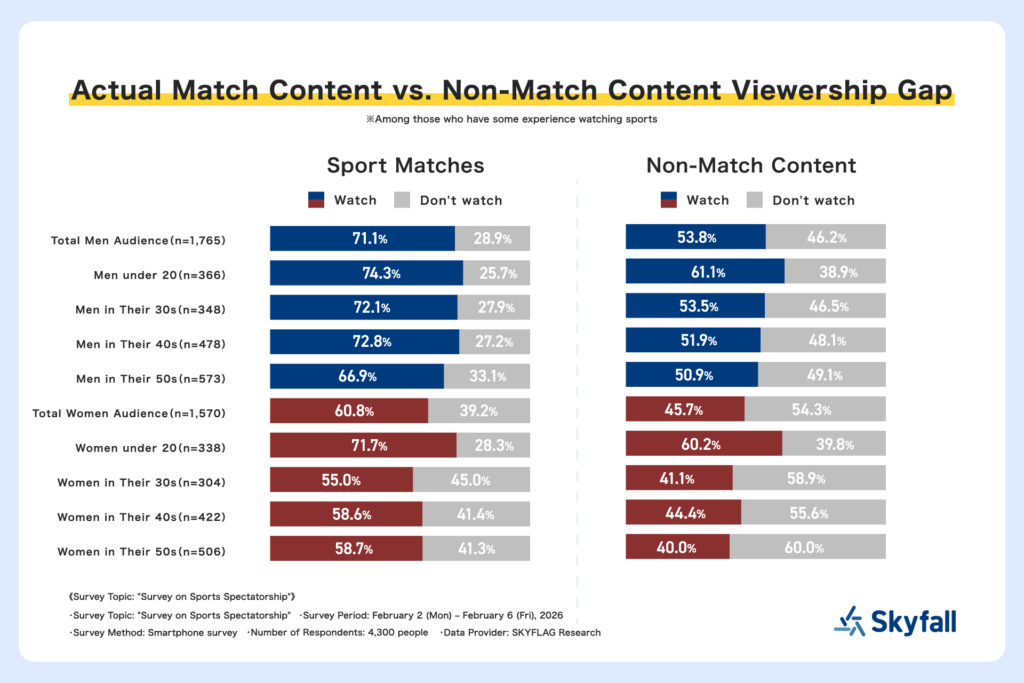
When 3,335 individuals who have at some point in their life watched sports were asked about “watching sport matches versus watching non-match content,” men (n=1,765) outpaced women (n=1,570) in stating that they watch both match content and non-match content. Broken down by age, both men and women aged 29 and under showed higher viewing ratios compared to other generations.
While matches are generally recognized as the primary content, viewers aged 29 and under—regardless of gender—stand out as an enthusiastic audience that heavily consumes non-match content as well. For women, the viewership ratio drops from their 30s onward, suggesting that changes in life stages may be a contributing factor.
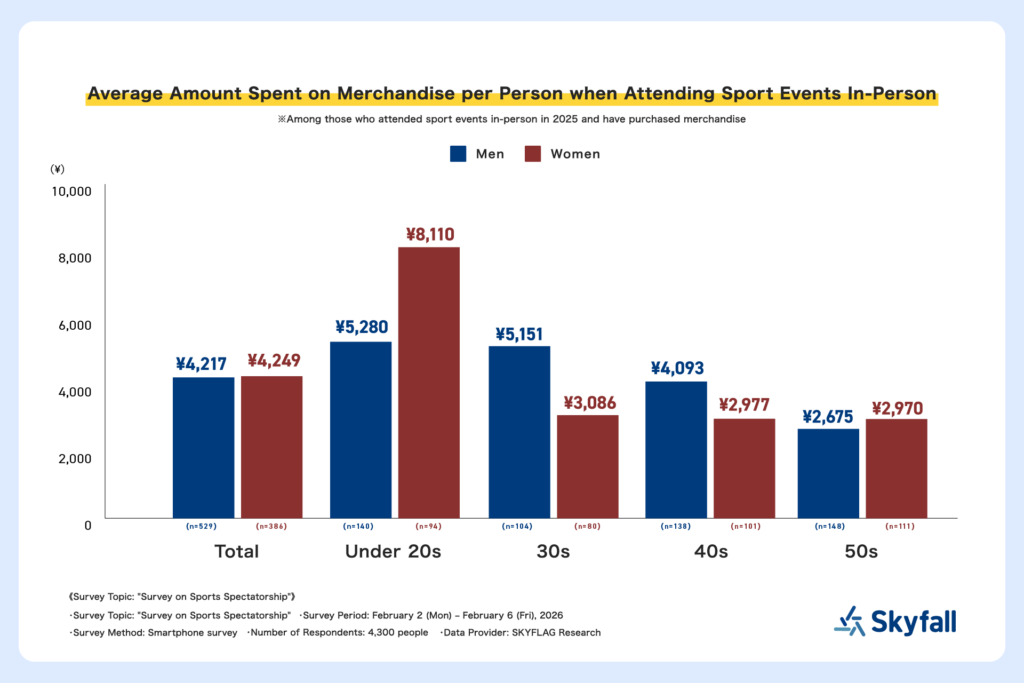
Next, among 915 individuals who attended sports events live at venues in 2025 and had experience purchasing merchandise, a question regarding the “average amount spent on merchandise at venues per visit” revealed that women aged 29 and under (n=94) recorded the highest average expenditure overall at 8,110 JPY.
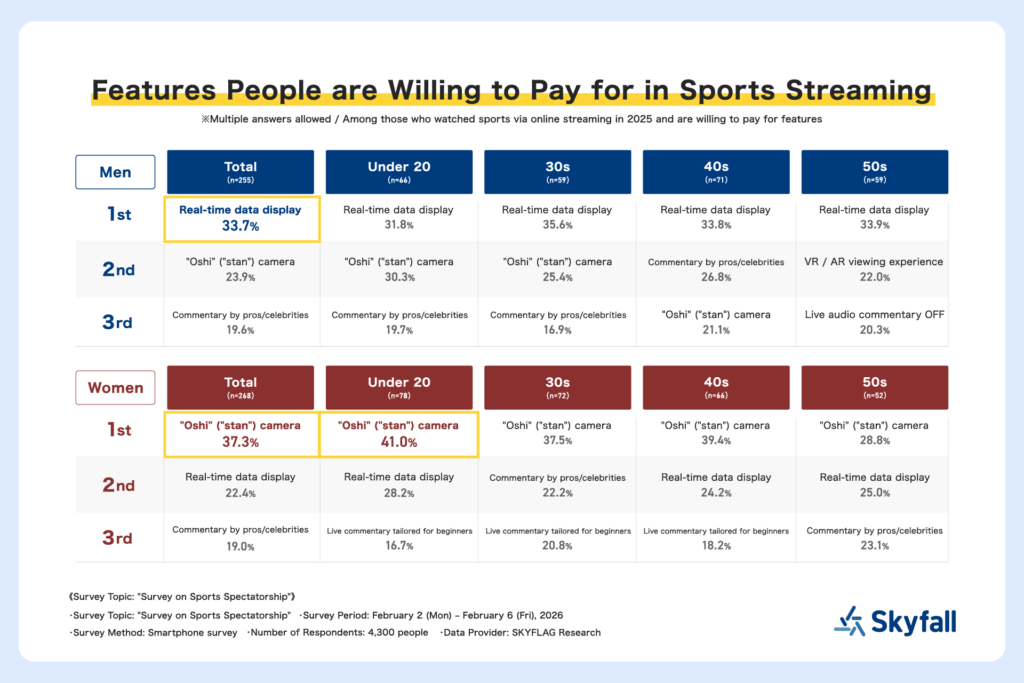
Additionally, among 800 streaming viewers in 2025, 523 individuals who expressed a willingness to pay for specific features were asked about the “features they would like to use” (multiple answers allowed). Broken down by gender and age, the demand for a dedicated “Stan Focus Camera (Oshi-Camera)” (camera to focus on their preferred player) was high among women across all generations, peaking significantly at 41.0% among women aged 29 and under (n=78). Conversely, the demand for “Real-Time Data Display” was higher among men across all age groups, highlighting a strong interest in match analysis.
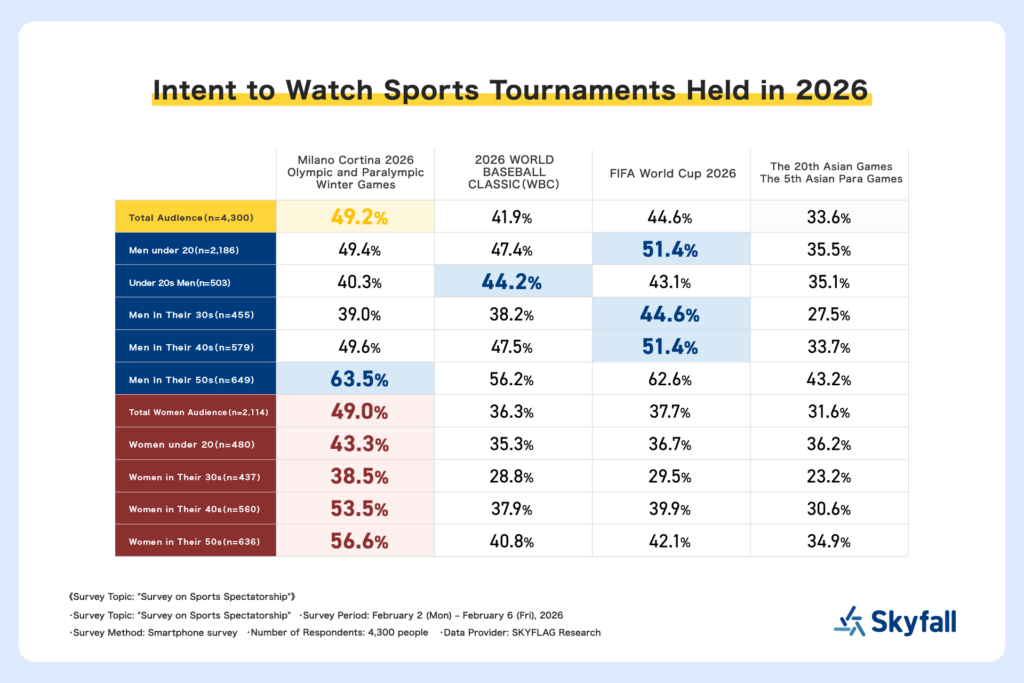
Viewership Intent for 2026’s Successive International Tournaments: Women Show High Interest in the “Olympics/Paralympics,” While Men Focus on the “WBC” and “World Cup,” Revealing Variations in Enthusiasm Across Genders and Generations.
When 4,300 individuals nationwide aged 18 to 59 were surveyed regarding their “viewership intent for sports tournaments taking place in 2026,” the “Milano Cortina 2026 Winter Olympic and Paralympic Games” topped the list at 49.2%, followed by the “FIFA World Cup 2026” at 44.6%, and the “2026 WORLD BASEBALL CLASSIC (WBC)” at 41.9%.
Looking at the data by gender and age group, men aged 29 and under (n=503) expressed the highest interest in the “2026 WORLD BASEBALL CLASSIC (WBC),” while men in their 30s (n=455) and 40s (n=579) favored the “FIFA World Cup 2026.” Meanwhile, women across all generations showed the highest interest in the “Milano Cortina 2026 Winter Olympic and Paralympic Games,” illustrating distinct preferences in sports spectatorship trends between men and women.
About “SKYFLAG Research”

“SKYFLAG Research” is a marketing research service that pursues representativeness. By expanding opportunities for internet research survey responses through various media via “SKYFLAG,” rather than being limited to conventional point sites, we support business decision-making with essential research results.
- Service Site: https://research-skyflag.info/
About “Skyfall”

| Company Name | : Skyfall Inc. |
| CEO | : Tomokazu Hasegawa |
| Address | : (Tokyo Head Office) 19F Midtown Tower, 9-7-1 Akasaka, Minato-ku, Tokyo : (Niigata Office) Nippon Life Insurance Niigata Building 7F, 2-4-10 Higashiodori, Chuo-ku, Niigata-shi, Niigata |
| Business Description | : Reward Marketing Platform Business / Other |
| Number of employees | : 200 (As of the end of December 2025) |
| Established | : October 2017 |
| Capital | : 79,393,750 yen |
| Website | : https://skyfall.co.jp/ |